The Hard Truth Nobody Wants to Say Out Loud
If your home has been sitting, the market isn't ignoring you. It's answering you. And the answer is the price.
Here's what I see every week in Baldwin Hills, Ladera Heights, View Park, Inglewood, Leimert Park and West Adams. Sellers want 2021 prices. Buyers want 2019 deals. And the
house sits in the middle, collecting days on market and quiet price cuts. After 13+ years selling homes in South LA, and working with a lot of expired-listing sellers,
I can tell you this: the pricing strategies that worked three years ago are now costing sellers money. If you are truly motivated to sell, price and strategy are everything.
Emotion is not a strategy. Data is.
The LA Market by the Numbers: Prices are still near record highs, but fewer buyers can afford them, so homes that miss on price get passed over.
What we're tracking: The Latest numbers & what it means for sellers
LA County median price (Sept. 2026) $994,670, up 1.2% year over year, Values are holding. Your equity is real.
LA Metro home sales (Sept. 2026), Down 8% year over year, Fewer buyers are actually closing.
LA Metro pending sales (Sept. 2026) Down 16% year over year, Buyers are waiting, watching, and negotiating.
30-year mortgage rate (Freddie Mac, Nov 5, 2026), 7.18% Up from a 2026 low near 6.09%.
Every dollar of price costs buyers more. Your buyer is not just comparing your house to the house down the street. They're comparing it to renting, to waiting, and to every other neighborhood on their phone. Through the buyer's eyes, today's buyer is paying more per month than any buyer before them, so they judge every detail against the price.They aren't shopping one neighborhood anymore. A buyer touring Ladera Heights on Saturday is also looking at Culver City, Westchester, even The Valley. They have options, time, and a calculator.
What we're tracking & What it means for sellers
LA metro listings with a pricecut (Sept 2026), 17.1%, up 1.9 points from last year, Roughly 1 in 6 sellers already priced too high.
California sale-to-list ratio (Sept 2026), 98.8% Well-priced homes still sell close to asking.
LA County median asking rent (Q3 2026), $2,554, down 3.6% Owning costs nearly $5,000 a month more than renting. Buyers have a real alternative.
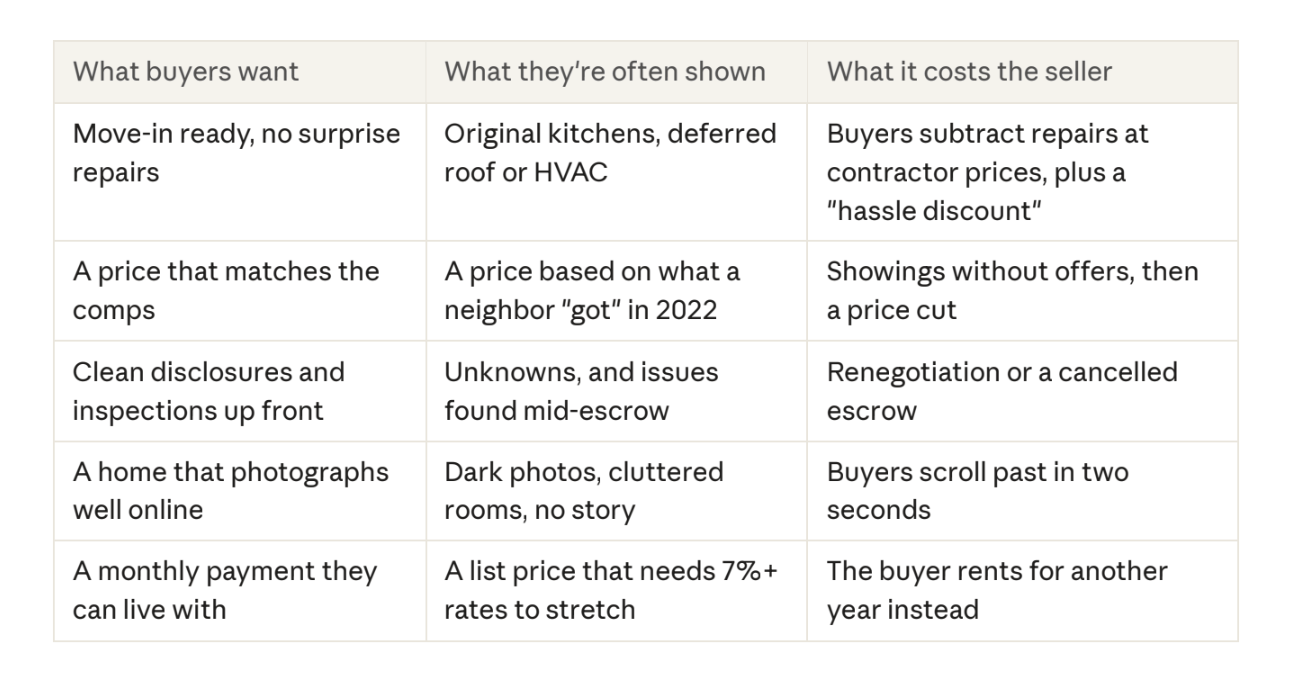
Buyers aren't being difficult. At $994,670 and 7% rates, they're being careful. Your home has to earn their offer.
Price to Sell vs. Price to Sit
Pricing high "to leave room to negotiate" no longer works, because buyers simply skip overpriced homes instead of negotiating. The old playbook was simple: list high, let the market come to you, accept multiple offers. That only works when buyers outnumber homes. Today, buyers filter by price online, watch days on market, and wait for the cut.
Pricing to sit looks like this:
Listed on emotion, what you need, or what a neighbor got two years ago, lots of online views, few showings, no offers.
First price cut after 30 to 45 days, and buyers start asking "what's wrong with it?" The home sells for less than if it had been priced right on day one, or it expires
Pricing to sell looks like this:
Priced from recent closed comps, adjusted honestly for condition. Strong showings and real interest in the first 2 to 3 weeks, when attention is highest. Offers close to list, from buyers whose loans will actually appraise. A clean escrow and a closing on your timeline
Underpricing hurts too. A seller who lists below market value leaves money on the table. The goal isn't high or low. It's accurate.
How to Price It Right: Think Like the Appraiser
The right price is the one the bank's appraiser will support, because most buyers need a loan and the lender won't lend more than the home is worth. Lenders require an appraisal on the vast majority of purchases, since the home is their collateral. If the appraisal comes in under your contract price, someone has to cover the gap: the buyer brings more cash, you lower the price, or the deal falls apart. A smart agent anticipates the appraised value before you ever list, so you avoid that renegotiation.
1. Start with closed comps, not active listings. Active listings are asking prices. Closed sales from the last 3 to 6 months, nearby and similar in size, age and style, are what an appraiser uses.
2. Adjust honestly for condition. Appraisers note age, quality and remaining life of the home. A dated kitchen, an older roof or deferred maintenance lowers value, even if the neighbor's house sold high.
3. Watch the trend, not just the number. In a market where 1 in 6 listings has cut its price, comps from the spring may already be too optimistic.
4. Price inside buyers' search brackets. Buyers search in ranges like $900K to $1M. A home at $1,015,000 misses everyone searching under $1M.
5. Consider a pre-listing appraisal. If the numbers are unclear, an independent appraisal before listing gives you a neutral, data-backed starting point.
6. Know the rental value too. If you're on the fence about selling, a fair rental estimate shows you the real alternative to a price cut.
One caution for sellers: once a purchase contract is signed, it's binding. If the appraisal comes in higher than your sale price, that's not grounds to renegotiate. Price it right up front.
Invest a Little, Then Get Honest About Why You're Selling: A few targeted investments win more buyers than a higher price ever will.
Investments that pay off with today's buyers:
- Fresh neutral paint, inside and out where needed
- Repairs a buyer's inspector will flag: roof, plumbing, electrical, HVAC
- Updated lighting, fixtures and hardware
- Curb appeal: landscaping, a clean entry, a painted front door
- Professional staging and photography that tell your home's story
- A pre-listing inspection, so there are no surprises mid-escrow
Then ask yourself the real question: how motivated am I?
- Do I need to sell by a certain date, or am I testing the market?
- What happens to my plans if this home is still unsold in 90 days?
- Am I pricing based on what I need, or on what buyers will pay?
- Would I buy my own home at this price, at today's rates?
If you're truly ready to move on, the market will meet you when the price and the presentation are right. If you're not ready, that's okay too. But don't spend six months on
the market to find out. Let's look at the data together. I'll walk you through the real comps for your home, what an appraiser will likely see, and a pricing strategy built to sell, not sit.
Beita Williams, BrokerAssociate | Compass | DRE #01953382 310-242-3965 |
Sources
LA metro pending sales, September 2026 (NMP)
Freddie Mac 30-year rate, November 5, 2026
2026 rate low and inflation context (Bankrate)
LA metro price-cut share, September 2026 (Realtor.com data)
Realtor.com Q3 2026 Los Angeles Rent Report
Appraisal concepts: your licensing course, Chapter 1, Basic Appraisal Concepts